SDK and Firmware Architecture

SDK and Firmware Architecture

The /IOTCONNECT™ SDK provides a clear separation between your device firmware/application logic and cloud communication. This page documents the architecture layers, how the SDK abstracts all cloud complexity, and what each layer is responsible for — enabling developers to focus on hardware and business logic without touching MQTT, TLS, or protocol details.

Three-Layer Architecture

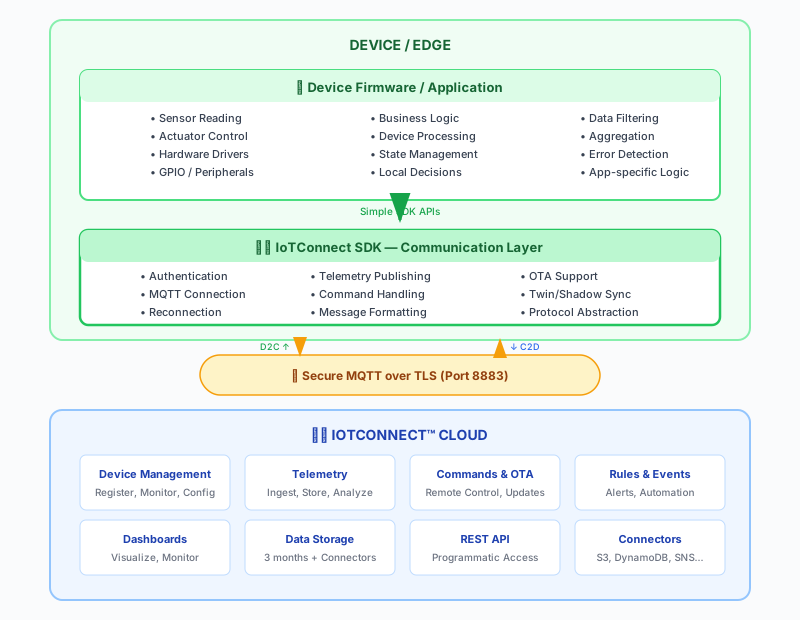
/IOTCONNECT SDK Three Layer Architecture

The /IOTCONNECT™ device architecture consists of three cleanly separated layers:

Layer 1 — Device Firmware / Application: Your code. Reads sensors, controls actuators, implements business logic, manages hardware. This layer knows nothing about MQTT, TLS, or cloud protocols.

Layer 2 — /IOTCONNECT™ SDK: The communication abstraction layer. Handles discovery, authentication, MQTT connectivity, telemetry publishing, command callbacks, twin/shadow sync, OTA, and certificate management. Your firmware interacts with it through simple API calls.

Layer 3 — /IOTCONNECT™ Cloud: The platform services. Device management, telemetry storage, rules engine, dashboards, commands, OTA, and connectors.

The SDK is the bridge. It abstracts all cloud communication complexity so your firmware code remains clean, portable, and focused on device functionality.

SDK Public API (What Your Firmware Calls)

Based on the actual /IOTCONNECT™ SDK implementation, here is the complete public API surface your firmware interacts with:

Initialization and Connection:

Method Purpose
Init(cpId, uniqueId, environment, platform, options, callback, settingCallback) Initialize SDK with device credentials and platform identity
Connect(successCallback, failedCallback, connectionStatusCallback) Establish connection to /IOTCONNECT™ cloud (handles Discovery + Auth + MQTT)
Disconnect() Gracefully close cloud connection
Dispose() Clean up all SDK resources

Telemetry (Device → Cloud):

Method Purpose
SendData(json) Publish telemetry data to /IOTCONNECT™ cloud
SendImage(path) Upload image file to cloud storage
UploadImage(filePath) Upload image with automatic handling
UploadImageWithClassification(filePath, classification) Upload image with AI classification metadata

Device Identity Messages:

Method Purpose
GetHelloMessage(callback) Get device metadata, protocol info, and capability flags (mt: 200)
GetAttributes(callback) Fetch template attribute definitions (mt: 201)
GetSettings(callback) Fetch device twin/shadow desired properties (mt: 202)
GetRules(callback) Fetch edge rules for local processing (mt: 203)
GetChildDevices(callback) Get registered child devices list (mt: 204)
GetPendingOTAUpdates(callback) Check for pending firmware updates (mt: 205)
GetPendingCommands(callback) Check for pending commands (mt: 206)

Commands (Cloud → Device Callbacks):

Method Purpose
OnDeviceCommand(callback) Register handler for device commands from cloud
OnOTACommand(callback) Register handler for OTA firmware update commands
OnModuleCommand(callback) Register handler for module push commands
OnSettingChangeCommand(callback) Register handler for twin/shadow setting changes
OnAttrChangeCommand(callback) Register handler for attribute definition changes
OnDeviceChangeCommand(callback) Register handler for child device changes

Acknowledgements:

Method Purpose
SendAckCmd(ackGuid, status, msg) Acknowledge command execution (success/failed)
SendOTAAckCmd(ackGuid, status, msg) Acknowledge OTA update status
SendAckModule(ackGuid, status, msg) Acknowledge module command execution
UpdateSetting(property, value, version, callback) Report setting/twin property back to cloud

Certificate Management:

Method Purpose
OnCertificateReceived(callback) Handle certificate renewal from cloud
OnCertSignedRequest(callback) Handle CSR-based certificate rotation
SubmitCSR(csr, signature) Submit Certificate Signing Request for rotation

Responsibility Separation

Your Firmware / Application /IOTCONNECT™ SDK (Handled For You) /IOTCONNECT™ Cloud
Hardware drivers (GPIO, I2C, SPI, UART) Discovery API call and endpoint resolution Device registry and management
Sensor reading and data collection MQTT connection over TLS (port 8883) Telemetry ingestion and storage
Actuator and motor control X.509 certificate authentication Command routing and delivery
Business logic and local decisions Automatic reconnection with backoff Rules and event processing
Data filtering and aggregation Telemetry JSON formatting and publishing Dashboards and visualization
Calling SDK APIs when communication needed Command reception and callback dispatch OTA firmware management
Processing received commands Twin/Shadow synchronization Data connectors (S3, DynamoDB, etc.)
Device state management Certificate rotation and renewal REST API for integrations
Error handling for hardware Offline storage and retry queue User and role management

Data Flow Diagrams

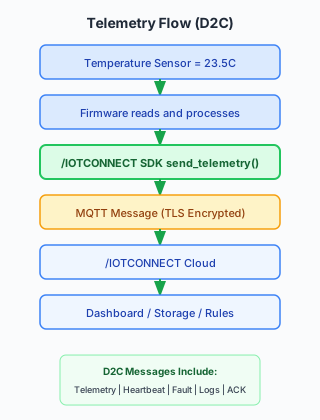
Device to Cloud Telemetry Flow
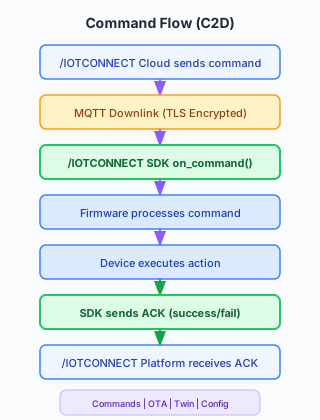
Cloud to Device Command Flow

SDK Internal Layers

Inside the SDK, the following internal layers handle cloud communication (your firmware never interacts with these directly):

Internal Layer Responsibility Key Components
Discovery Resolves cloud endpoints from CPID + Environment HTTPS call to discovery.iotconnect.io
Identity Fetches device config, attributes, topics, auth type Agent Sync API call
Broker Manages MQTT connection lifecycle MQTTnet client, TLS, QoS 1
Message Handler Formats outgoing JSON, parses incoming commands Protocol 2.1 message serialization
Certificate Manager Handles cert rotation, CSR flow, renewal X.509, private key management
Offline Storage Queues telemetry when disconnected File-based queue with configurable size
Data Validator Validates telemetry against template schema Attribute type checking before publish

Why This Architecture Matters

Portable: Same firmware code runs on any hardware. Only the SDK platform layer changes between MCU, Linux, Windows.

Maintainable: Cloud protocol changes (new message versions, endpoint migrations) are handled by updating the SDK NuGet package — zero firmware code changes.

Secure: Certificate management, TLS, and authentication are handled inside the SDK. Firmware developers cannot accidentally bypass security.

Testable: Firmware logic can be unit tested without cloud connectivity. Mock the SDK interface for isolated testing.

Resilient: Offline storage, automatic reconnection, and retry are built into the SDK. Firmware does not need to handle network failures.

Multi-platform: The SDK is available for C, Python, C#, Node.js, Java, Android, and iOS — all with the same architecture pattern.

SDK Configuration Options

When initializing the SDK, you configure these options (from SDKOptions):

Option Description Default
DiscoveryURL Custom discovery endpoint (for non-default regions) https://discovery.iotconnect.io
IsDebug Enable verbose SDK logging false
Certificate.CACertificatePath Path to device CA certificate file (.pem) Required for cert-auth
Certificate.PrivateKeyCertificatePath Path to device private key file (.pem) Required for cert-auth
Certificate.Password Certificate password (if encrypted) Optional
OfflineStorage.Disabled Disable offline message queuing false (enabled)
OfflineStorage.AvailSpaceInMb Max disk space for offline queue Unlimited
OfflineStorage.FileCount Number of offline storage files 1
DevicePK Device primary key (for symmetric auth) Optional
IsDataFreqEnable Enforce minimum telemetry send interval true

ⓘ SDK AVAILABILITY

The /IOTCONNECT™ SDK is available for: C (embedded), Python, C# / .NET, Node.js, Java, Android, and iOS. All SDKs follow this same three-layer architecture pattern. The API surface is consistent across languages — learn once, apply everywhere.