
Architecture

Platform Architecture

Understand the layered architecture of /IOTCONNECT™ — from smart devices and communication protocols through the platform core to the application layer where business value is realized.

Architecture Overview

/IOTCONNECT™ is built on a microservices-based architecture that provides scalability, resilience, and flexibility. The platform is deployed on cloud infrastructure (AWS / Azure) and structured into distinct functional layers, each responsible for a specific set of capabilities.

This layered approach ensures that each component can scale independently, be updated without impacting other services, and maintain high availability across the entire system.

Application layer: Web Portal, Dashboards, REST APIs, Mobile Apps, Third-party Integrations

Platform core layer: Device Management, Rule Engine, Data Processing, OTA, Commands, User Management

Communication layer: MQTT Broker, HTTPS, WebSockets, SignalR

Device identity & security Layer: X.509 Certificates, TPM, SAS Tokens, device Authentication, Certificate Management

Edge & device layer: IoT devices, Sensors, Gateways, Edge Gateways, Greengrass, Wireless, SDKs (Python, C, Node.js, Java, C#)
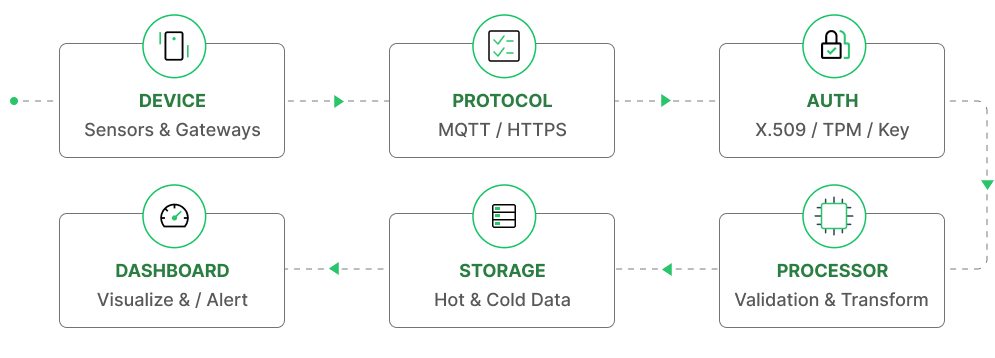
Data Flow

The typical telemetry data flow through the /IOTCONNECT™ architecture:

For cloud-to-Device communication, the flow is reversed: an API call or rule action generates a command that is queued and delivered to the Device through the persistent MQTT connection or on the next Device poll for HTTPS-connected Devices.

Edge and Device Layer

The edge and device layer is where physical IoT Devices, sensors, and gateways operate. Devices connect to /IOTCONNECT™ using device SDKs available in multiple programming languages including Python, C, Node.js, Java, and C#. For edge computing scenarios, /IOTCONNECT™ integrates with AWS IoT Greengrass to enable local data processing, machine learning inference, and intermittent connectivity handling.

Supported device types include smart devices (direct cloud connection), edge device (local processing with cloud sync), and edge gateway devices (aggregating data from multiple child devices).

Device Identity and Security Layer

Security is foundational in /IOTCONNECT™. Every device must authenticate before communicating with the platform. The security layer supports multiple authentication mechanisms:

  • X.509 certificates: Industry-standard certificate-based authentication for enterprise deployments with full certificate lifecycle management including rotation and revocation.
  • TPM (Trusted Platform Module): Hardware-based security using tamper-resistant chips for the highest level of device identity protection.
  • Symmetric key / SAS token: Token-based authentication suitable for constrained devices or rapid prototyping scenarios.
  • Individual enrollment: Per-device provisioning for controlled high-security environments.
  • Group enrollment: Bulk device provisioning using certificate chains for manufacturing-scale deployments.

Platform core Layer

The platform core is the engine of /IOTCONNECT™, consisting of independent microservices that process, route, and store IoT data:

  • Device management: Registration, provisioning, lifecycle management, twin management, and device grouping across the fleet.
  • Message processor: Ingests telemetry data at scale, validates message schemas, transforms payloads, and routes data to storage and processing pipelines.
  • Rule engine: Evaluates real-time conditions on incoming telemetry and triggers actions such as alerts, commands, webhooks, or email notifications.
  • OTA updates: Manages firmware and software updates for devices with scheduling, rollback, and group targeting capabilities.
  • Command service: Enables cloud-to-device communication for remote configuration, reboots, and custom device actions.
  • Data storage: Persists telemetry data with configurable retention, supporting both hot (real-time queries) and cold (long-term analytics) storage patterns.
  • User & Entity management: Multi-tenant hierarchy with role-based access control, entity structures, and organization-level isolation.

Application Layer

The application layer is where users interact with the platform and business value is realized. This includes the /IOTCONNECT™ web portal for device management, customizable dashboards with live and audit widgets, REST APIs for programmatic access, and connectors for integrating with external systems.

The REST API provides full programmatic access to all platform capabilities, enabling custom application development, automation workflows, and integration with existing enterprise systems such as ERP, CRM, and BI tools.

Scalability and high availability

/IOTCONNECT™ is designed to handle millions of concurrent device connections and process high-throughput telemetry streams. The microservices architecture enables horizontal scaling of individual components based on load. The platform leverages managed cloud services for message queuing, data storage, and compute, ensuring automatic failover and geographic redundancy.

Integration Architecture

/IOTCONNECT™ provides multiple integration points for connecting with external systems. Data connectors support NoSQL databases (DynamoDB, CosmosDB), messaging services (SNS, Event Hub), and live streaming (SignalR, MQTT). The event system enables webhook-based integrations for real-time notifications. The complete REST API enables any custom integration scenario.